Melissa Sanchez Herrera and I are organizing a Sys-EB Section symposium for the 2019 EntSoc meeting in St. Louis, MO.
The symposium is entitled:
Bugs in Technicolor: How Color Research Advocates for Entomology
The reflection and emission of light from insect surfaces has both fascinated and inspired entomologists and the general public for centuries. The goal for our symposium is to provide a setting in which to discuss color research and its use in public outreach initiatives that aim to inspire insect curiosity and advocate for entomology. We have talks that will be given by entomologists from different continents / countries working on diverse, ingenuitive projects that incorporate insect coloration components including production, structures, perception and selection.
In addition to these talks, we intend to have an electronic exhibit of images, illustrations, and videos that fulfill these criteria and we are thus seeking submissions for this endeavor.
If you are interested in including an image please fill out the form below and upload your image / video!

Lectures and Workshops

Insect Conservation
Adults
1–1.5 hours
PowerPoint
This lecture covers the current conservation status of insects and includes:
- Insect evolution
- Ecosystem services provided by insects
- Current threats to insects
- Summary of recent research that has documented major reductions in insects
- What we need to do to help conserve insects and what happens if we don't
- What you can do at your home or in your community to help conserve insects

Entomology for beginners
Adults
3 hours or three 1 hour sessions
PowerPoint
This is an extensive three-hour lecture that covers the basics of entomology. The lecture includes:
- Insect evolution
- The role of insects in science
- Overall insect anatomy and physiology
- The function of the exoskeleton and how / why they molt
- Different types of wings and how they fly
- Sensory systems - including mechanoreception, chemoreception, and photoreception
- Reproduction and development
- An overview of some of the orders we have in Virginia
- Ecosystem services provided by insects
- Current threats to insects and the major reductions we have seen in recent years
- What we need to do to help conserve insects
- What you can do at your home or in your community to help conserve insects
Aquatic Macroinvertebrates
Adults
1 hour
PowerPoint
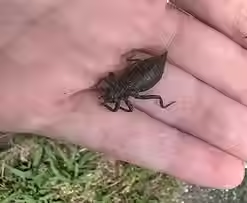
In this course we discuss the diversity of insects that we can use to assess water quality here in the Williamsburg, Virginia, area. We learn how to perform surveys, metrics that can be used for calculations, and pollution tolerance of common species.
This course does not have a workshop/field component at this time, as there has not been any expressed interest as of yet, but if that would be of interest to you, please let us know!

Aquatic Macroinvertebrates - Dry Lab
3rd–5th grade
1 hour
Interactive
In this course we will give your students the opportunity to sample macroinvertebrates, identify them and categorize them based on their tolerance to pullution, and them use them to calculate metrics and assess water quality -- all in the classroom! We have faux environments in which the students must search for small insect models, which are hidden in the soil, in plants, under rocks/logs, etc. All included insect orders/families are specific to our District here in Virginia.
The activity is an excellent opportunity for students to experience this type of field sampling without leaving the school and without making any sort of mess.
The activity would work best if there is a full hour available, but can be done in 45 minutes. Previous students have expressed their love for the activity and that they learned so much!
Beneficial Insects
Adults
1–2 hours
Lecture without PowerPoint (ppt under development)
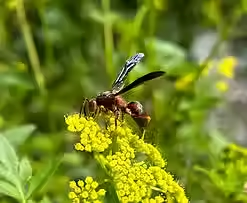
Insects are more than just bugs in the garden—they’re essential workers that pollinate, recycle nutrients, and keep pests in check. In this workshop, Amanda will uncover the hidden world of insects as she discusses their life cycles, diets, and the essential ecosystem services they provide in your garden. You’ll learn simple ways to attract and support pollinators and other beneficial insects, what garden practices to avoid, and the most eco-friendly options for dealing with problem pests when they show up.

Dragonflies and damselflies
Adults
1–1.5 hours
PowerPoint
In this course we will discuss how to identify the major Odonata families we have represented here in Virginia. The primary focus of the course is on adults, but could be adapted to include nymph identification is that is of interest to you. I will also teach you about their evolution, anatomy, how to differentiate between dragonflies and damselflies, their weird and wonderful life histories (including some very unique individuals), and why they are important to the ecosystem.

Get in Touch
Reach out to me via email to discuss my services.